MTCC Diagnostics
A consultant’s method rebuilt as configurable product infrastructure, from question design and respondent progress to scoring, comparison and reports.
- Product owner
- Consultant method, diagnostic content and interpretation
- QDev role
- Product architecture, UX, engineering and reporting
- Repository
- QZee-Ltd/mtcc · application monorepo
- Evidence
- Sanitised product captures, reviewed code and labelled sample reports
Preserve the method while removing its manual repetition
A consultant-led diagnostic combines intellectual property, facilitation and a chain of calculations. Questions can belong to categories and domains, response options can carry different values, some scoring runs in reverse, and an individual answer can later contribute to a grouped view. If that logic is re-created separately in a form, spreadsheet, dashboard and report, small differences make the output harder to trust.
MTCC models the framework as configurable data and keeps the calculation path in a shared core. Consultants use an admin application to define or import diagnostics, manage respondents and inspect results. Respondents enter through a focused tokenised runner that autosaves and resumes. An API coordinates data, email and exports. Shared packages carry scoring rules, Firebase integration and interface primitives across those applications.
The product supports distinct business, ISO 9001 and sentiment diagnostic types, including diagnostic-specific response language. That is evidence of configurable product behaviour, not ISO certification, accreditation or endorsement. QDev’s role covered product structure, user journeys, application engineering, scoring implementation, visual reporting and export design. The consultant remained the authority on the diagnostic method and its use.
Build the invariant core before multiplying outputs
2025 · Definition
Translate the consulting framework into data
Mapped diagnostic types, questions, options, weighting, reverse scoring, categories, domains, respondents and engagements into configurable records.
2025 · Core build
Separate consultant and respondent work
Created focused admin and runner applications over one API and shared calculation model, with tokenised access and resumable progress.
2026 · Analysis
Extend one scoring path into group views and exports
Added respondent and role filtering, ECharts visualisation, spreadsheet interoperability and structured export formats.
2026 · Reporting
Make the consulting outcome the product's final state
Connected the score model to designed report outputs. Commit e11ad600a678 evidences report integration only, not the whole product or its production release.
Every application, shared package and output path
Capability status definitions
- LiveAvailable in a public or deployed product.
- ImplementedBuilt, but release or approval is not evidenced.
- DemonstrationA labelled example using simulated data.
- ExploratoryResearch, specification or prototype only.
Consultant admin
The operating workspace for diagnostic configuration, engagements, respondents and analysis.
- Question and option configuration
- Spreadsheet import and versioning
- Invitation and respondent management
- Individual and grouped results
Repositoryapps/admin
Respondent runner
A focused assessment experience that hides scoring machinery and preserves progress.
- Tokenised access
- Autosave and resume
- Diagnostic-specific response labels
- Review and completion
Repositoryapps/runner
Application API
The service boundary for diagnostics, engagement state, invitations, analysis and export work.
- Express routes
- Firebase data access
- Postmark email
- Account-scoped request paths
Repositoryapps/api
Scoring and analysis
One shared model rolls answers into comparable category, domain and group results.
- Weighted and reverse scoring
- 1 to 5 and 0 to 100 representations
- Respondent and role filters
- Grouped aggregation
Repositorypackages/core
Visual and file outputs
Charts and exports carry the same result model into consultant analysis and client handoff.
- ECharts circumplex and result views
- CSV and XLSX
- JSON
- PDF reports
Repositoryapps/admin + packages/core
Published report examples
Sample documents show the intended hierarchy without revealing a client engagement.
- Twelve-area overview
- Strengths and focus areas
- Domain detail
- Sequenced recommendations
RepositoryReport integration at e11ad600a678
Two focused interfaces, one calculation path
From framework to usable report
- ConfigureDefine or import questions, response options and scoring rules.
- RunInvite a respondent into a tokenised assessment that autosaves.
- AnalyseRoll weighted answers into category, domain and group views.
- UseReview charts, export structured files and produce a report.
The live entry points evidence deployed access. They do not independently verify tenant isolation. Sample reports evidence output design, not client outcomes.
Inspect runner (opens in a new tab)The operating product behind the report
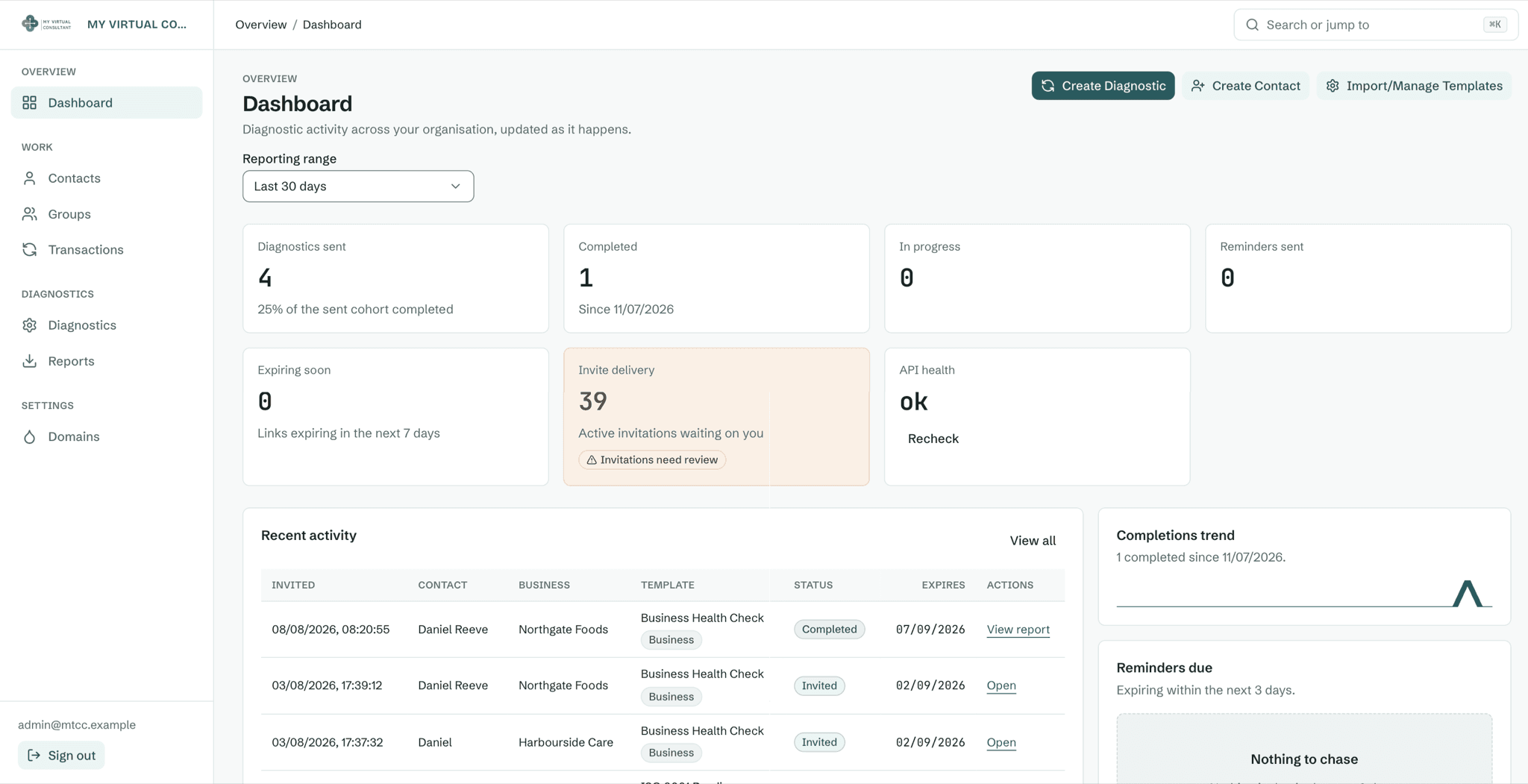
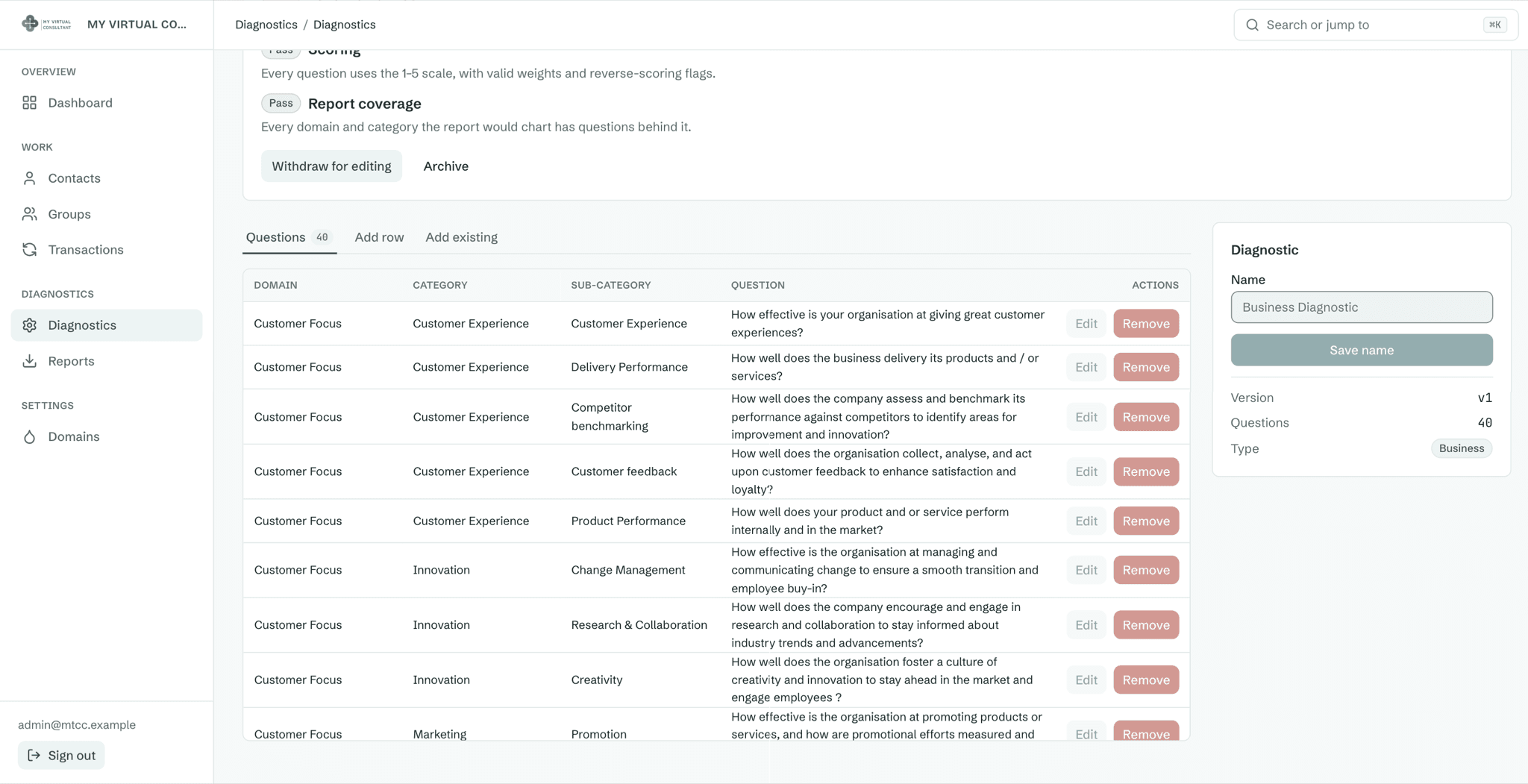
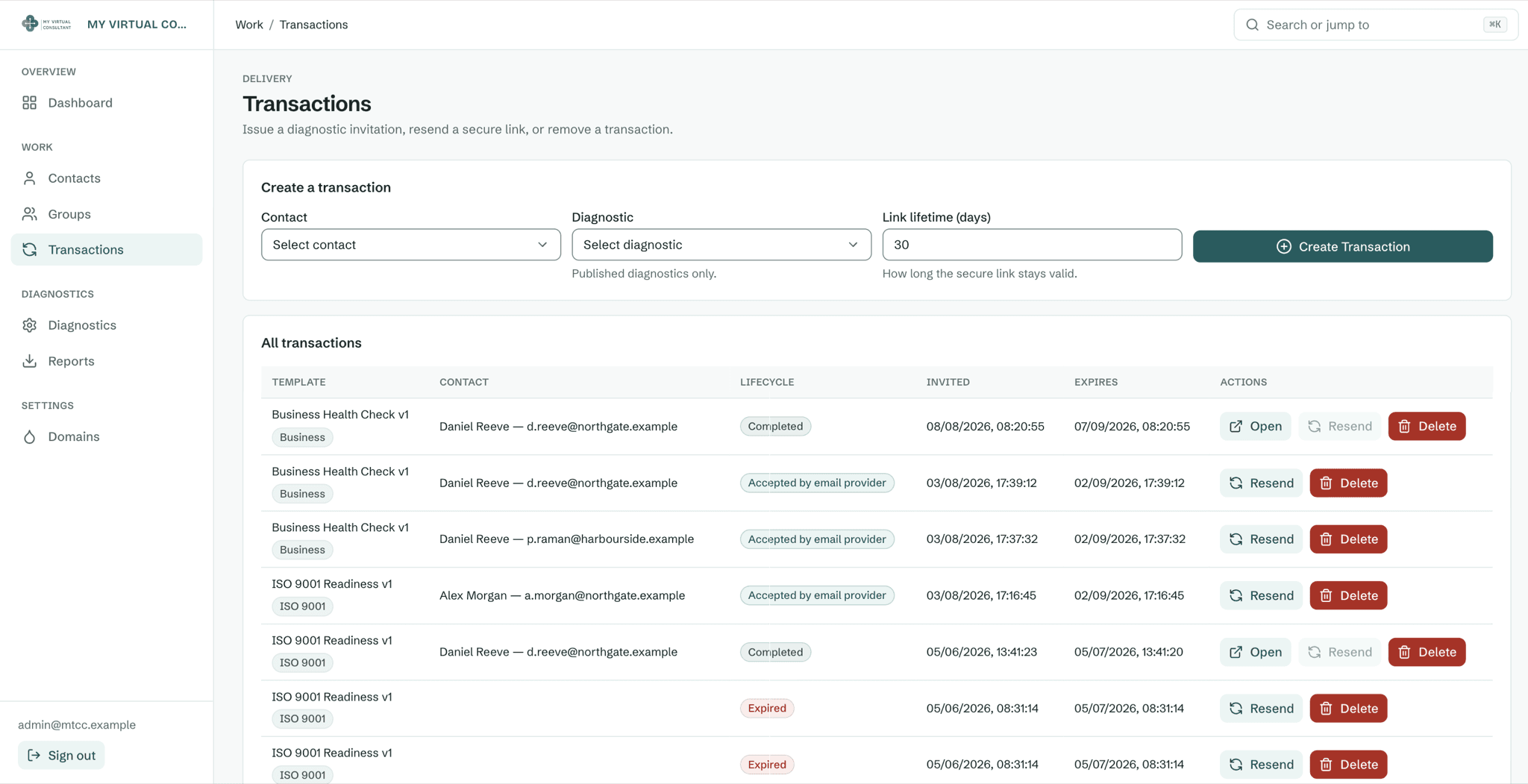
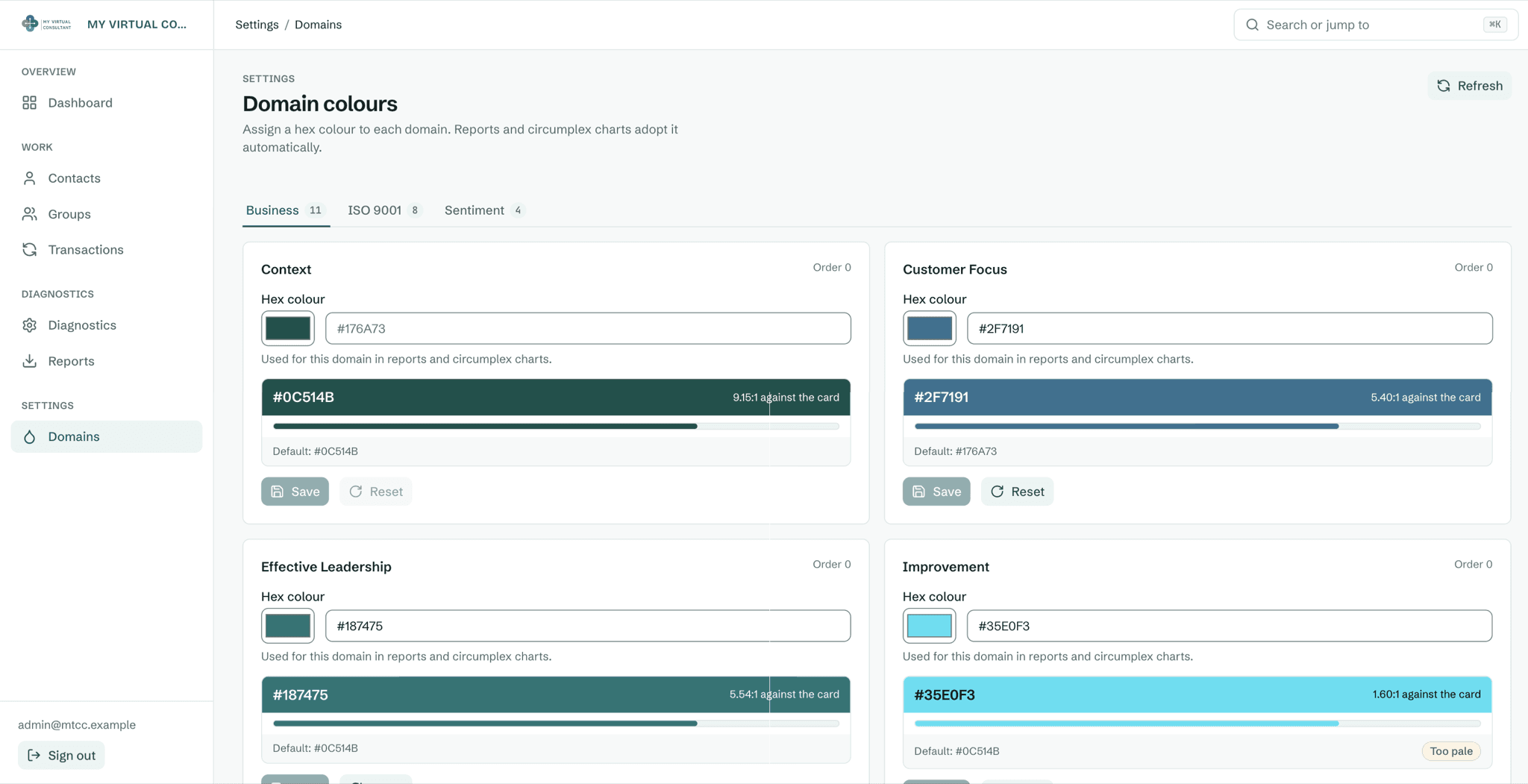
These sanitised captures come from the working consultant application. They show how a framework is made publishable, how invitations are tracked and how report colours are checked before any result reaches a client. Fictional data replaces real contacts, organisations and diagnostic titles.
From score pattern to next action
The report pages use demonstration data. Together they show the output hierarchy: first the overall pattern, then domain-level interpretation, then a practical sequence of actions.
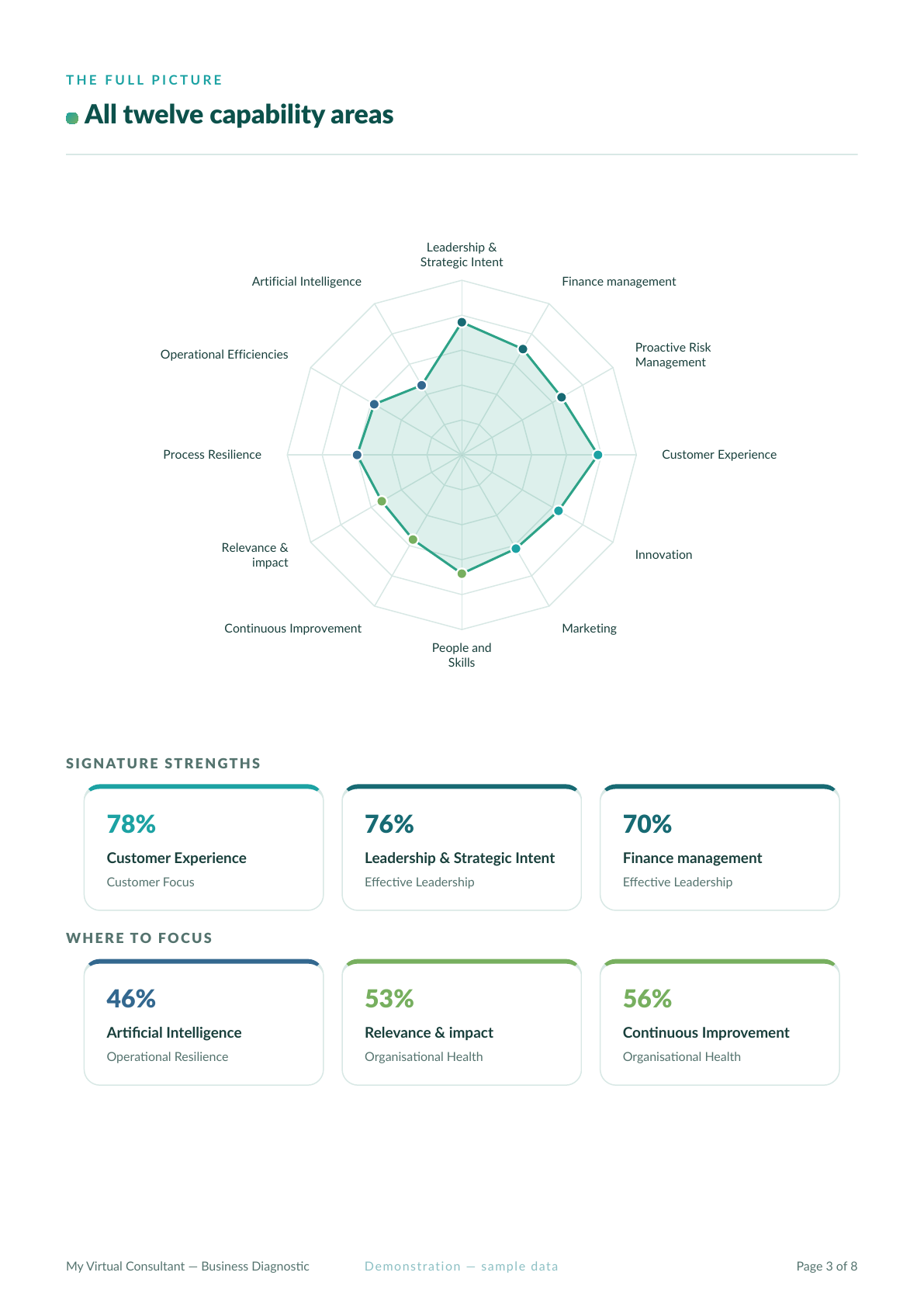 Demonstration data
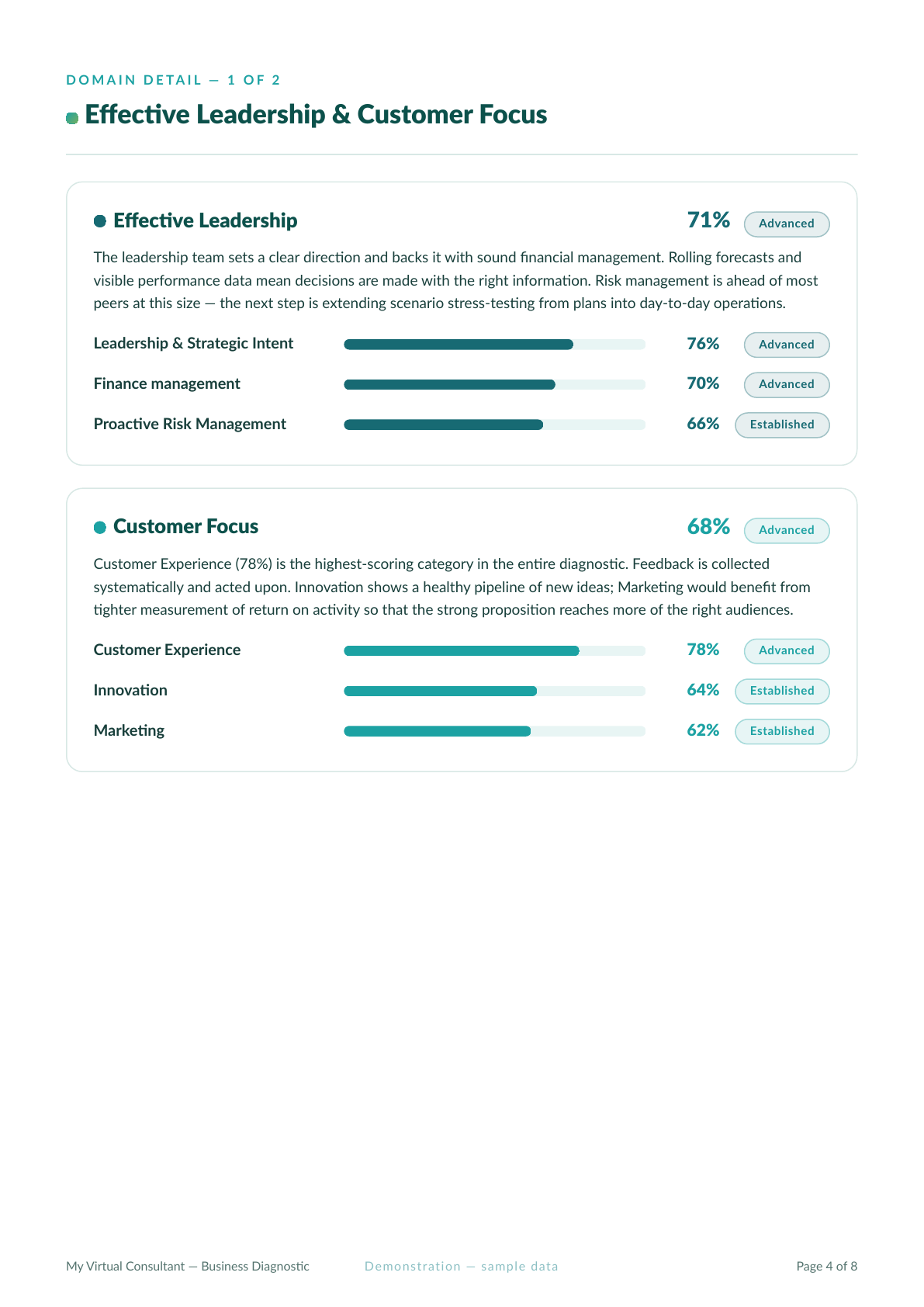 Demonstration data
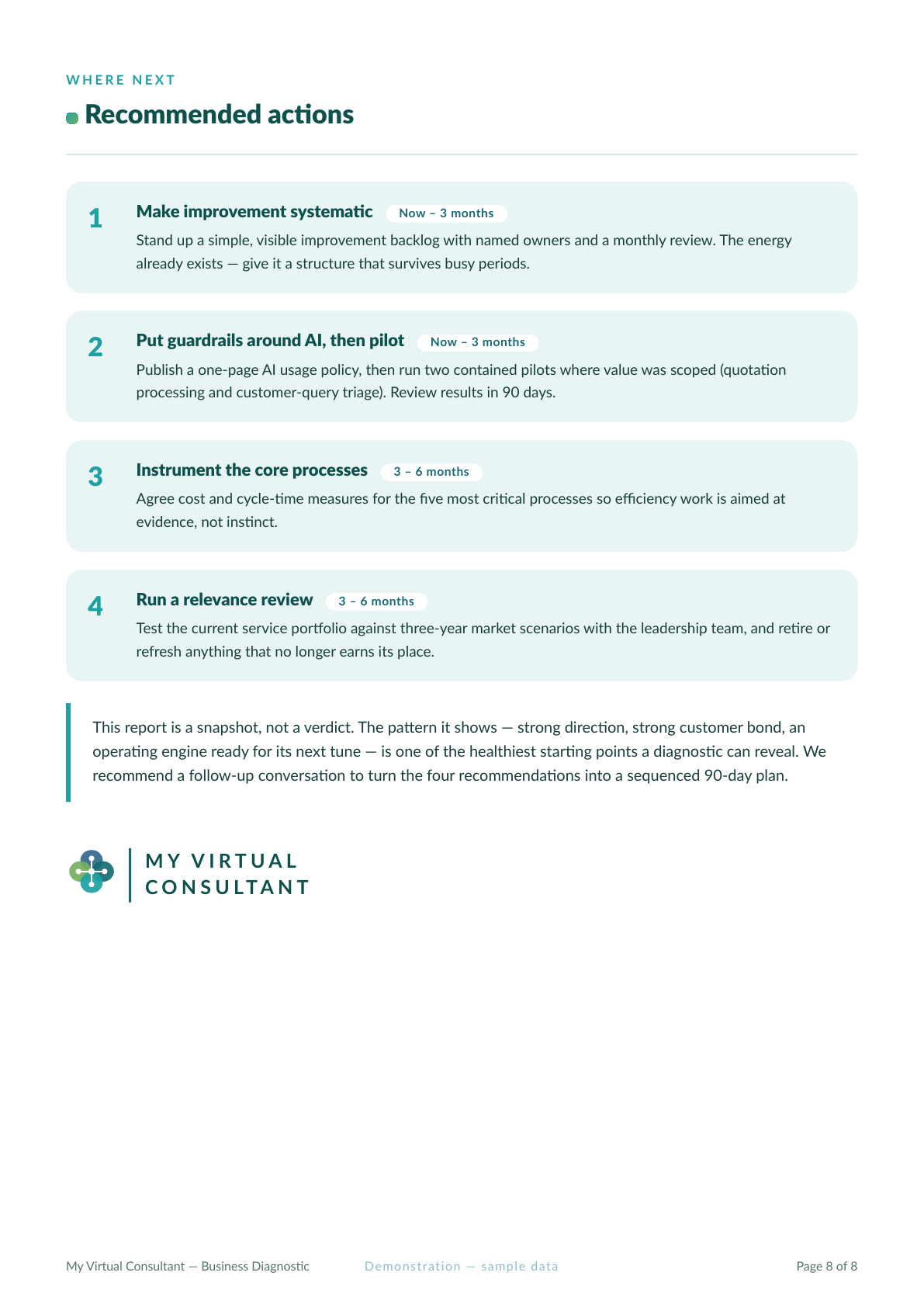 Demonstration data
The choices that make a configurable method dependable
Model the method as data
- Decision
- Represent diagnostic types, questions, options, weightings and hierarchy as configurable records.
- Why
- The consultant needs to adapt the framework without asking engineering to rebuild an assessment.
- Consequence
- Business, ISO 9001 and sentiment diagnostics can share infrastructure while preserving their own language and rules.
- Tradeoff
- Configuration needs validation and versioning because a flexible model can create invalid combinations.
Centralise scoring
- Decision
- Keep weighted, reverse, category, domain and group calculations in a shared core package.
- Why
- The admin view, charts and exports must not derive different answers from the same responses.
- Consequence
- One calculation path can feed analysis, ECharts and every export format.
- Tradeoff
- Changes to the core require broad regression coverage because they affect every downstream output.
Split admin, runner and API
- Decision
- Use separate applications for consultant work, respondent completion and server responsibilities.
- Why
- Respondents need a low-distraction experience and should not inherit the admin application's controls or information density.
- Consequence
- Each application can optimise for its audience while sharing domain, UI and Firebase packages.
- Tradeoff
- Cross-application contracts and releases need coordination inside the monorepo.
Autosave the respondent journey
- Decision
- Use tokenised access with resumable progress instead of requiring one uninterrupted assessment session.
- Why
- Long diagnostics are more reliable when an interruption does not erase completed thought or force hurried answers.
- Consequence
- Respondents can return to a known state and consultants receive more controlled completion behaviour.
- Tradeoff
- Token lifecycle, partial state and expiry become explicit data and support concerns.
Design backwards from the report
- Decision
- Treat grouped results, focus areas and recommended actions as a primary product outcome.
- Why
- The diagnostic only creates value when a consultant can interpret and act on the pattern, not when a form is merely submitted.
- Consequence
- Question structure, scoring and visualisation are tested against the quality of the final consulting conversation.
- Tradeoff
- Report design exposes gaps in upstream data early and requires parity across screen and file outputs.
One monorepo, three applications, three shared foundations
Consultant application
QZee-Ltd/mtcc · apps/admin
LiveOwns diagnostic configuration, imports, engagements, respondents, analysis, charts and report workflows.
- React
- ECharts
Live authenticated entry and reviewed application code.
Respondent application
QZee-Ltd/mtcc · apps/runner
LiveOwns token entry, question progression, autosave, resume, review and completion.
- React
- Token access
Deployed runner route and reviewed application code.
Service application
QZee-Ltd/mtcc · apps/api
LiveCoordinates Firebase data, account-scoped routes, invitations, analysis support, Postmark email and export work.
- Express
- Firebase
- Postmark
Account scoping is documented and implemented. Independent isolation testing is not claimed.
Shared domain package
QZee-Ltd/mtcc · packages/core
ImplementedCarries diagnostic models, scoring behaviour and reusable result logic across applications and outputs.
- TypeScript
- Scoring
Reviewed monorepo package and downstream use.
Shared interface package
QZee-Ltd/mtcc · packages/ui
ImplementedProvides reusable interface foundations while allowing admin and runner workflows to remain distinct.
- React
- UI primitives
Reviewed package boundary.
Shared data package
QZee-Ltd/mtcc · packages/firebase
ImplementedCentralises Firebase integration used by the application and service layers.
- Firebase
Reviewed package boundary. No independent security certification is implied.
A repeatable consulting product with a visible reasoning chain
MTCC moves a configurable method out of one-off documents and spreadsheet assembly. Consultants can define, invite, compare and export from one system; respondents get a focused, resumable experience; and the same scoring logic reaches the chart, grouped view and report. The result is a product foundation for repeatable diagnostic work, not a static questionnaire.
Continuing development should pair that foundation with approved outcome evidence: completion behaviour, time saved in analysis, scoring regression coverage and verified tenant-isolation tests. None of those measures is inferred from the demonstration reports.
Turn your expertise into a product.
Define the rules, evidence and experience before development with product definition.
Discuss a project